Rules of Blackjack
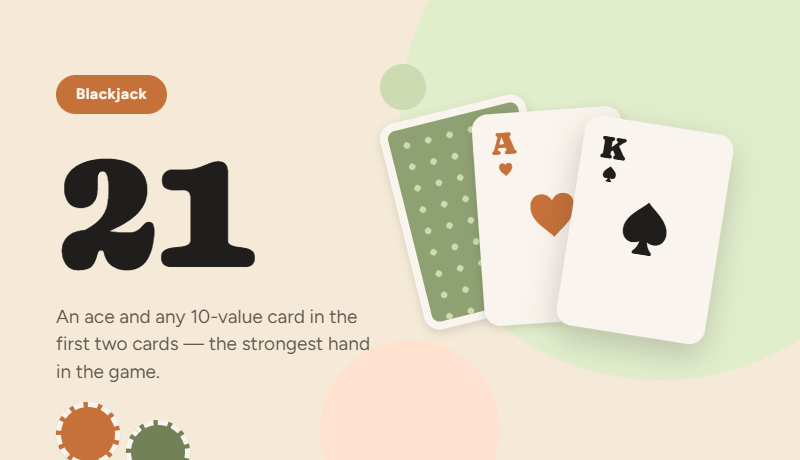
Blackjack is one of the most popular casino card games, where the player competes not against other players but directly against the dealer. After each bet, players are dealt two cards face up, while the dealer receives two cards, one of which is hidden face down (the so-called “hole card”). The goal of the game is to get a point total closer to 21 than the dealer without going over that mark, or to wait for the dealer to bust (go over 21).
Unlike many other casino card games, card suits have no meaning in blackjack — only the face value of a card matters for scoring.
Card values
- Cards from 2 to 10 are worth their face value. For example, a combination of a 5 and a 9 adds up to 14 points.
- Face cards — Jack, Queen and King — are worth 10 points each.
- The Ace can be worth 1 or 11 depending on the situation: if the total including the ace does not exceed 21, the ace counts as 11; if adding 11 would cause a bust, the ace is valued at 1.
A hand with an ace that can count as 11 without busting is called “soft” — for example, an ace and a 6 make a “soft 17”. Such a hand is safe: by taking a card, the player cannot bust, because the ace will “turn into” a 1 if needed. A hand without an ace, or with an ace that already counts as 1, is called “hard”.
The term “blackjack” refers not only to the game itself, but also to the strongest combination: an ace plus any 10-value card (ten, Jack, Queen or King) in the first two cards. A blackjack beats any other combination totaling 21 points made with three or more cards.
Payouts
- A regular win (a higher point total than the dealer, or the dealer busts) pays 1:1 — the player receives winnings equal to the bet.
- Blackjack traditionally pays 3:2, meaning a bet of 100 brings 150 in winnings. Beware: some casinos pay 6:5 — this is significantly worse for the player, and such tables are best avoided.
- A tie (Push) — if the player and the dealer have the same point total, the bet is simply returned to the player.
- A loss — if the player busts or scores less than the dealer, the bet is lost. Important: if both the player and the dealer bust, the player still loses, because players act first.
Dealer rules
The dealer acts strictly according to fixed rules and makes no decisions:
- The dealer must draw cards while their total is less than 17.
- At 17 or higher, the dealer stands. In some game variants the dealer also stands on a “soft 17” (the S17 rule — better for the player), in others the dealer must hit on a “soft 17” (the H17 rule — better for the casino). This rule is usually printed right on the table.
Player options
After the cards are dealt, players always make their decisions first. There are four main actions:
- Stand. The player takes no additional cards and keeps the current hand unchanged. This usually happens when the score is high enough and close to 21, or when the risk of busting is high and the dealer shows a weak upcard.
- Hit. The player takes an additional card from the deck. They may continue taking cards until they bust or decide to stop.
- Double. The player doubles the original bet after receiving the first two cards and gets exactly one additional card, after which no more moves are allowed. This lets you increase the potential payout in a favorable situation — usually with 10 or 11 points in hand, especially when the dealer shows a low upcard.
- Split. If the player has two cards of the same value (for example, two Jacks or two eights), they can split them into two separate hands by placing an additional bet equal to the original one. Each card becomes the first card of a new hand, one card is added to each, and the hands are then played independently. Splitting is especially advantageous with a pair of aces or eights. Note the nuances: when splitting aces, most casinos deal only one card to each hand, and an “ace + ten” combination after a split counts as a regular 21, not a blackjack, and pays 1:1.
If the dealer’s upcard is an ace or a 10-value card, the dealer (in the American version of the game) immediately checks the hole card for blackjack. If there is a blackjack, the round ends immediately: all players without blackjack lose, while players with blackjack get a push. In the European version, the dealer receives the second card only after all players have completed their moves.
The Surrender option
The Surrender option gives the player the chance to give up and keep half of the bet if they consider their chances of winning low. The action is available only immediately after receiving the first two cards, before any other moves. There are two types of surrender:
- Early Surrender. The player may surrender before the dealer checks the hole card for blackjack. This is the most favorable option for the player, but it is rarely offered.
- Late Surrender. The player may surrender only after the dealer has checked the hole card, and only if the dealer does not have blackjack. If the dealer has blackjack, surrendering is no longer possible — the entire bet is lost.
Surrendering is mathematically justified in a limited number of situations — for example, with a “hard” 16 against a dealer’s ten or ace.
Insurance
If the dealer’s upcard is an ace, the player is offered an additional bet on the dealer having blackjack. The insurance amount is half of the main bet, and it pays 2:1:
- If the dealer really has blackjack, the insurance wins and compensates for the loss of the main bet — the player breaks even.
- If there is no blackjack, the insurance is lost and the game continues as usual.
Mathematically, insurance is unprofitable for the player in the long run: the probability of the dealer having blackjack is lower than the 2:1 payout implies, so experienced players generally do not take it.
Even Money
If the player has blackjack and the dealer shows an ace, some casinos offer to take an immediate 1:1 payout without waiting for the dealer’s card to be checked. Essentially this is the same as insurance, and it is mathematically unprofitable as well.
Basic strategy: a few pointers
Blackjack is one of the few casino games where correct decisions noticeably reduce the house edge (with precise basic strategy — down to roughly 0.5%). A few general principles:
- Always split aces and eights; never split tens and fives.
- Double on 11 against almost any dealer card, and on 10 against dealer cards from 2 to 9.
- With a “hard” 12–16, stand if the dealer shows a weak card (2–6): there is a high chance the dealer will bust.
- With a “hard” 12–16, hit if the dealer has a strong card (7 or higher).
- With “soft” hands you can act more boldly: it is impossible to bust with one card.
- Do not take insurance.
Other useful information
- Number of decks. Blackjack is played with one to eight decks. The fewer the decks, the better for the player (all other rules being equal).
- Gestures at a live table. In land-based casinos, decisions are traditionally shown with gestures: tap the table to take a card, wave a palm over the cards to stand. This is done for the surveillance cameras.
- Rules vary. The availability of surrender, doubling rules after a split, the number of allowed splits, S17/H17 and the blackjack payout size differ from casino to casino and from one game variety to another. Before playing, it is worth checking the rules of the specific table — they directly affect the player’s odds.